Quick answer: Hara helps dietitians follow patients’ food and symptom records between visits. AI takes a first pass at meal photos, patients correct the details, and dietitians review patient-shared records in Hara Care Portal to confirm the next nutrition step. It supports IBS and IBD follow-up; professional review happens within your practice’s agreed workflow.
Patient-approved sharing. Follow-up messaging when enabled. AI drafts require review.
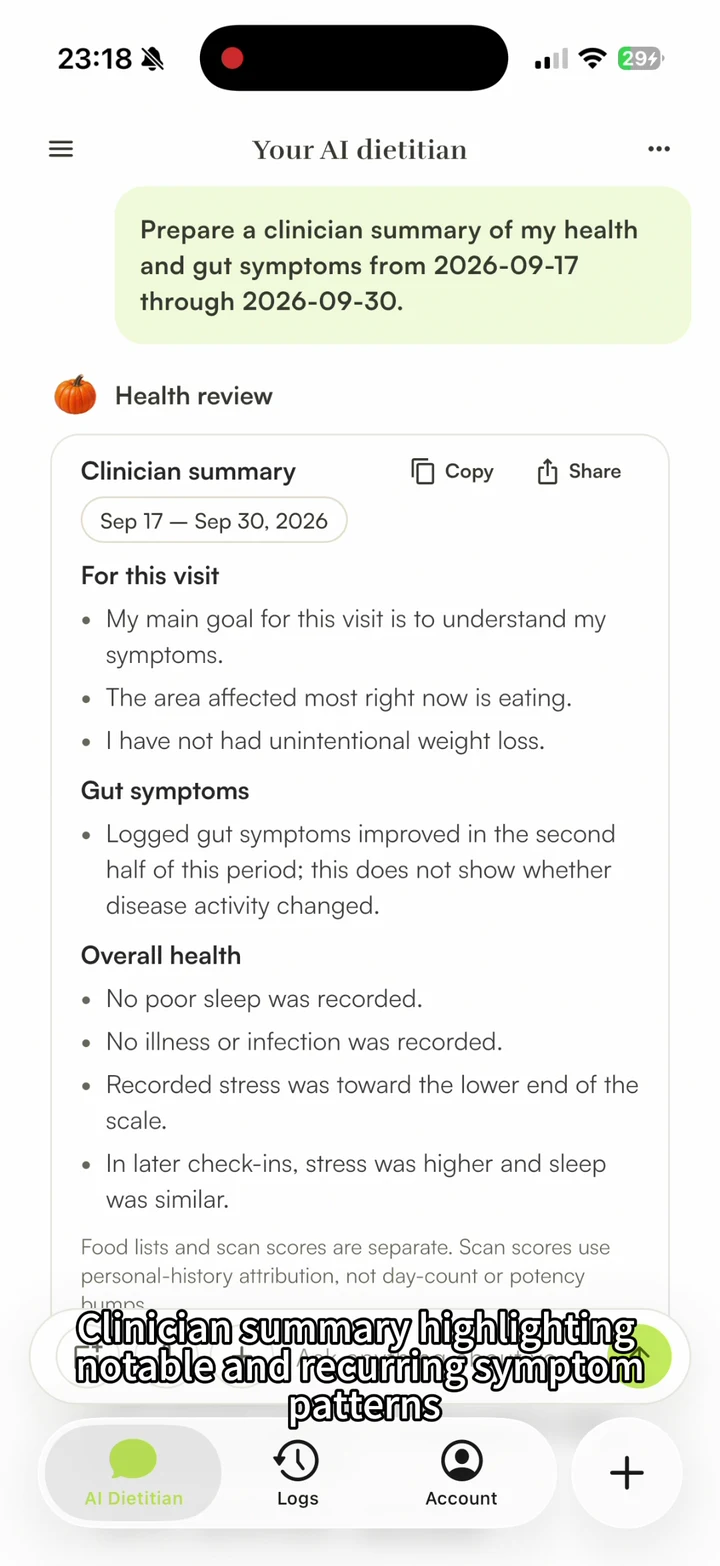
Inside HaraActual app screen
Actual patient-app summary. The dietitian reviews shared source records in Care Portal; this screen is not a clinician sign-off interface.
A practical workflow
AI organizes the meal. You confirm what matters.
A photo can help a patient start a record while the meal is still in front of them. It cannot reliably reveal every ingredient, the portion eaten or how the patient felt later. Use the draft as the start of a conversation.
01
Agree on the question
Choose a focused review question with the patient: missed meals, portion changes, a repeated symptom or how a planned food change went. Agree on a review period and how to contact the practice.
“What should we record before our next visit?”
02
Let AI take a first pass
The patient photographs a meal or describes it. Hara helps identify likely foods and ingredients. The patient checks the draft and adds portions, preparation and anything the photo missed.
“That sauce was dairy-free; I ate half the rice.”
03
Review the shared context
With the patient’s permission, review meals alongside reported reactions, timing, check-ins and missing days. Include meals without noticeable symptoms when comparing experiences.
“Does this happen every time, or only in some contexts?”
04
Confirm the next step
Use your clinical judgment to confirm the interpretation and agree on a practical nutrition step. Follow up through messaging when enabled, or through your usual care channel.
“Let’s review the meal details before changing the plan.”
What AI prepares—and what you review
On a small screen, scroll the table sideways.
What AI prepares—and what you review
In the record
AI or patient contribution
Dietitian review
Meal photo
A draft description of foods and possible ingredients.
Confirm ingredients, portion eaten and missing details with the patient.
Meal and symptom history
Reported timing, severity, symptom-free meals and daily context.
Assess whether the record is sufficient and what else could explain a pattern.
Draft summary
Available records organized for discussion.
Check the underlying entries, gaps and clinical relevance.
A meal idea or food question
Options using the preferences and history the patient shares.
Confirm fit with the agreed plan and the patient’s nutrition needs.
Keep the context
A focused review for IBS. A separate clinical lens for IBD.
For IBS follow-up, use specific meal and symptom records to discuss a plan you have already agreed with the patient. Avoid turning every association into another restriction.
For Crohn’s disease or ulcerative colitis, recorded symptoms add context but do not establish inflammatory activity. Your clinical assessment and the patient’s IBD care plan remain essential.
Patients choose to connect and share. Review only the records available to you.
Set expectations
Agree how often your team reviews records and which contact channel patients should use.
Confirm, then advise
Human review is a care workflow, not a guarantee that every AI response has already been approved.
Useful answers
Before you start.
Can dietitians use Hara to monitor IBS patients between visits?
Hara supports review of patient-shared meals, reported symptoms and daily context in Care Portal. Review frequency and follow-up arrangements depend on the practice; it is not continuous clinical monitoring.
Does a dietitian approve every AI meal-photo response?
No. Hara can provide an AI draft before professional review. Patients should correct missing or inaccurate meal details, and dietitians can review shared records to confirm advice within their care workflow. Do not assume an AI response is dietitian-approved.
Can patients and dietitians message each other?
Follow-up messaging is available when enabled. Agree on response expectations and urgent-care contact instructions before using it between visits.
Is Hara an electronic health record or a registered dietitian?
No. Hara is an AI food-guidance and record-organizing app. Care Portal supports professional review of patient-shared information; it does not replace a registered dietitian, a clinical assessment or a complete medical record.
Bring the days between visits into the conversation.
Explore how meal-photo drafts and patient-shared records could fit your practice’s review routine.