Start with the agreed plan
Keep your clinician’s current instructions available. Note questions about ingredients or substitutions before changing foods on your own.
“Which details should I record during this phase?”
Hara food records · Eosinophilic esophagitis
By Hara Health · Updated
Quick answer: Hara’s meal and symptom records can help people with eosinophilic esophagitis (EoE) organize food details and questions for their dietitian or GI team. AI can draft meal details for you to correct, and you can share selected records. Hara is a general food-guidance app, not an EoE-specific diagnostic tool; diary patterns cannot confirm an EoE food trigger or treatment response.
Use alongside your clinician-directed plan. Do not start or change an elimination diet based on app suggestions.
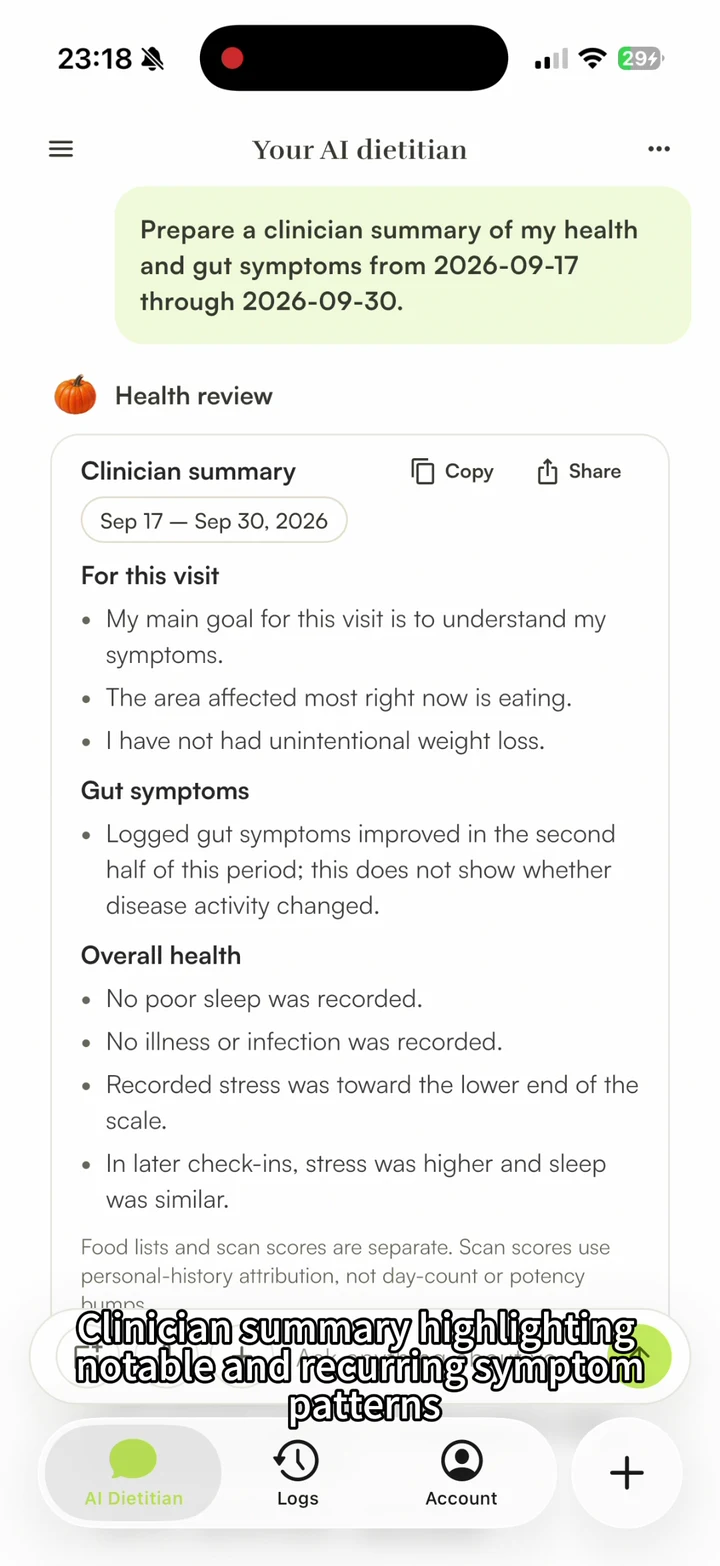
A practical workflow
If your care team has recommended dietary therapy, a consistent record can help you explain what you actually ate and where the plan was difficult to follow. It cannot show what an esophageal biopsy would show.
Keep your clinician’s current instructions available. Note questions about ingredients or substitutions before changing foods on your own.
“Which details should I record during this phase?”
Use a photo or description, then check the ingredients against the label or recipe. Add brands, substitutions and preparation details in your notes where useful.
“The recipe changed; here is the ingredient list.”
Use your own words for symptoms and any changes in how you eat. Bring swallowing difficulties to your clinician rather than treating the log as a diagnosis.
“I want to discuss how eating has changed.”
Bring selected meal records and questions to your dietitian or GI team. They decide the plan, the timing of food reintroduction and how to assess response.
“What needs clarification before the next phase?”
On a small screen, scroll the table sideways.
| Record | Useful for discussion | Does not establish |
|---|---|---|
| Meal photo and corrected ingredient details | What you remember eating and which details are uncertain. | Allergen absence, cross-contact safety or a confirmed EoE trigger. |
| Notes about symptoms and eating changes | What changed and what you want your clinician to evaluate. | Whether esophageal inflammation has improved. |
| Questions about a prescribed diet phase | Where you need clarification from your care team. | Permission to eliminate or reintroduce foods independently. |
Keep the context
The American College of Gastroenterology’s EoE guideline summary recommends dietitian involvement when dietary therapy is chosen and assessment with endoscopy and biopsy rather than symptoms alone. Feeling better after avoiding a food does not, by itself, confirm it as an EoE trigger.
An AI photo check may miss ingredients and cannot verify allergen absence or cross-contact. Check labels and ask the food preparer; follow your care team’s instructions for EoE and any separate food allergy.
Food stuck and unable to pass needs emergency care. The ACG patient guide advises going to the emergency room for food impaction. Do not wait for an app response or routine message.
Useful answers
You can use Hara’s general meal, symptom and note-taking features to organize records for your care team. Hara does not provide an EoE-specific diagnostic assessment or validated EoE monitoring protocol.
No. AI may estimate visible foods and ingredients, but it cannot confirm an EoE trigger, detect every ingredient or verify cross-contact. Dietary changes and assessment belong with your clinical team.
Not necessarily. Symptoms alone do not reliably establish treatment response. Your clinician uses appropriate assessment, including endoscopy and biopsy, to evaluate EoE.
Hara supports patient-approved sharing through Care Portal and reports you can bring to a visit. Ask your dietitian which records and format they want to review.
Use general meal and symptom records to support the plan you have agreed together.