Compare the apps
Scroll sideways to compare features and limitations.
| App | Best for and key features | Main limitation |
|---|---|---|
| HaraSource ↗ | Agentic AI for food decisions. Whole-menu, meal-photo and label checks; reaction logs; meal planning using comprehensive data from food history and health check-ins; health reports and Care Portal. | AI may miss ingredients or context. A food check cannot establish medical safety. |
| MiraeSource ↗ | Broader IBD context and visit preparation. Food, symptom and medication records; available health-record and wearable connections; patient-chosen summaries. | AI interpretations need review. Mirae Consult is a separate clinician product; confirm access and connection details. |
| We IBDSource ↗ | An on-device IBD diary. Meals, stools, symptoms, daily context and a PDF for appointments, according to its Android listing. | Self-observation indicators are not diagnostic. Verify platform availability and how your care team will receive the report. |
| Crohn’s Food TrackerSource ↗ | Food and symptom timelines. Meal ratings, bowel records, ingredient-level association insights and PDF reports in the US iOS listing. | App-generated trigger labels do not confirm causation, inflammation or food safety; features vary by platform. |
| mySymptomsSource ↗ | Detailed food and symptom diaries. Barcodes, custom entries, association analysis, PDF/CSV export and Clinic sharing. | Useful analysis depends on consistent, sufficiently detailed entries. |
| My IBD CareSource ↗ | IBD education and care preparation. Symptoms, medicines, appointments, expert-led courses and ElenaAI. | Dish-by-dish menu analysis was not established in the reviewed sources. |
| Monash FODMAPSource ↗ | A tested-food FODMAP reference. Serving-size guidance, recipes, reintroduction tools and an exportable diary. | Designed around IBS; FODMAP content does not measure IBD inflammation. |
| SpoonfulSource ↗ | Comparing packaged groceries. Barcode/photo checks, dietary ingredient flags and product alternatives. | A dietary match does not establish your personal tolerance to a meal. |
| BowelleSource ↗ | A simple digestive-health diary. Meal photos, symptom and bowel records, charts and PDF/CSV reports. | Primarily an IBS diary; Apple Health context is available only on iOS. |
| BearableSource ↗ | Symptoms alongside broader health factors. Custom symptoms, food, medicines, sleep, mood and correlations. | A broad tracker needs setup; correlations still require interpretation. |
| FoodMarbleSource ↗ | Breath readings alongside meals. Food and symptom logs connected to a breath-testing device. | Breath testing requires compatible hardware and regular measurements. |
| Cara CareSource ↗ | Guided IBS support in an eligible region. Food and symptom records with program-specific education. | Products and access differ by country; verify the current regional offering. |
| Aidy · Official source | IBD treatment routines and daily records. Meals, symptoms and treatments, with physician reports. | Check the current workflow against your specific food-decision task. |
| Tolly · Official source | Food scanning and digestive journaling. Restaurant-menu analysis, modification tips and doctor reports. | AI menu estimates and risk labels do not establish food safety or inflammatory activity. |
Hara: menu checks connected to your history
- Compare a whole menu before ordering
- Hara checks menus, meal photos, labels and typed foods, including ingredients, portions and preparation. Monash focuses on FODMAP references; Spoonful on packaged-food checks.
- Use your data across an agentic workflow
- Hara’s agentic AI connects food checks, reaction logging, history retrieval and meal planning. It draws on the meals, symptoms, symptom-free records, daily check-ins and dietary preferences you share, with gut state, sleep and stress as context. Ask it to retrieve past reactions, suggest recipes or build a grocery list. mySymptoms and Bowelle emphasize diaries and retrospective review.
- Bring food records to your care team
- Export a health report or share selected food, symptom and daily-context records through Hara Care Portal. Several apps here also offer reports or shared access.
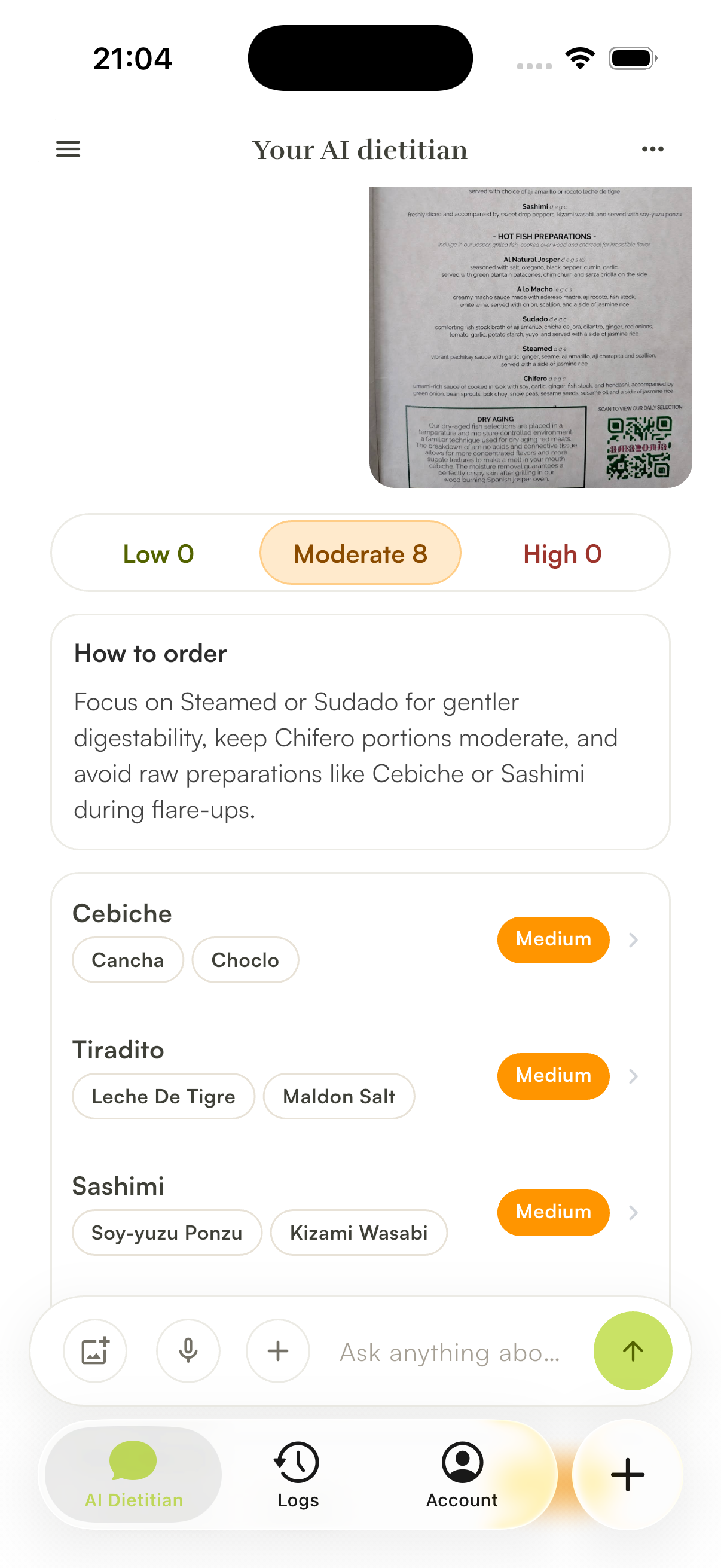
From a whole menu to individual dishes
Hara puts a “How to order” summary above the dish-level checks. Compare options, then confirm ingredients and preparation with restaurant staff.
Actual app screenshot. Open image to view full size.
Main limitation: AI may miss ingredients or misread a menu. Its usefulness also depends on the history you record; it cannot verify that a dish is medically safe.
Mirae: broader IBD context for care conversations
Mirae describes conversational logging of symptoms, food and medicines, connections to available health records and wearables, and summaries patients choose to share. Its Mirae Consult page separately describes clinician review with patient-approved access.
Main limitation: confirm which patient-to-clinician connection is available to you. The patient homepage and separate Consult offering describe different sharing workflows. AI interpretations remain subject to professional review.
We IBD: a local diary and appointment report
The We IBD Android listing describes keeping health records on the device, with meal and stool entries, symptoms, daily context and PDF reports. This suits a patient who wants a local record to bring to a visit.
Main limitation: its self-observation indicator is not a diagnostic score. We reviewed the Android listing; confirm availability on your device. The developer’s storage description is not an independent privacy audit.
Crohn’s Food Tracker: meal records and symptom patterns
Crohn’s Food Tracker is listed as Crohn’s Food & Symptom Tracker on the US App Store. It describes meal ratings, symptom and bowel records, ingredient-level association insights and PDF reports. The Android listing uses the title Crohn’s Tracker: Food & IBD.
Main limitation: treat trigger labels as hypotheses to discuss, not proof of causation or inflammation. Do not assume identical features across platforms.
mySymptoms: detailed food and symptom records
mySymptoms is a strong fit for detailed diary review: log food, drinks, medicines, bowel movements, sleep and symptoms using barcodes or custom entries. Association analysis and PDF/CSV exports help organize the record; mySymptoms Clinic supports clinician sharing.
Main limitation: useful analysis depends on consistent entries. Hara emphasizes using meal history in the next food question; mySymptoms emphasizes examining a detailed diary.
My IBD Care: an IBD-specific care companion
My IBD Care, developed with patients and clinicians, suits a broader IBD routine. It covers bowel movements, symptoms, medicines, reminders, appointments and expert-led courses. ElenaAI provides non-medical guidance using recorded patterns and helps prepare for appointments.
Main limitation: the reviewed sources did not establish dish-by-dish menu analysis. Choose it for IBD education and care preparation rather than assuming it performs a food scanner's task.
Monash FODMAP: tested foods and structured reintroduction
The Monash FODMAP app combines the university team's tested-food reference, serving-size traffic lights, recipes, reintroduction guidance and an exportable diary. It is a useful choice when your dietitian recommends a FODMAP approach.
Main limitation: it was designed around IBS. FODMAP content alone cannot determine whether a food fits your current Crohn's or UC needs.
Spoonful: ingredient checks while grocery shopping
Spoonful suits the grocery aisle: scan a barcode or product photo, see ingredients flagged for your selected dietary needs, and compare alternatives.
Main limitation: matching a dietary filter does not establish personal tolerance. You still need to consider your portion, preparation and what happened after eating.
Bowelle: a simple food, symptom and bowel diary
Bowelle is a straightforward IBS diary with meal photos, symptoms, bowel records, charts and PDF/CSV reports. It suits someone who wants to keep and share a digestive-health record without a broad care program.
Main limitation: its scope centers on IBS and diary review. Apple Health integration is available on iOS, not Android.
Bearable: see food alongside sleep, medicines and other factors
Bearable suits people tracking gut symptoms alongside other health concerns. Custom symptoms, food, medicines, sleep, mood, energy and activities help put difficult days in context.
Main limitation: a broad tracker requires choosing which fields matter. Its correlations describe patterns to investigate, not a diagnosis or proof of causation.
FoodMarble: breath readings alongside meal records
FoodMarble adds breath readings to meal and symptom logs. AIRE 2 measures hydrogen and methane, helping users review fermentation readings alongside food records.
Main limitation: breath testing requires compatible hardware and regular measurements. The device is not diagnostic, and its readings do not measure IBD inflammation.
Cara Care: check the regional program
Cara Care's current German offering is a structured IBS program with food and symptom records and dietary and behavioral content. Its US tracker listing describes a different product and program.
Main limitation: verify the exact app, country, eligibility and current support. Do not assume one region's program is available elsewhere or is an IBD care service.
How IBS and FODMAP tools fit into an IBD routine
The Crohn's & Colitis Foundation distinguishes symptom relief from inflammation. A four-week trial in 52 people with inactive IBD and persistent gut symptoms found more participants reported adequate symptom relief on a low-FODMAP diet, without a significant difference in inflammation markers between groups.
That supports a symptom-focused role in a specific setting, not a claim that a FODMAP score, breath reading or food app measures intestinal inflammation. Discuss dietary changes with your IBD team.
For condition-specific food questions, explore Hara for Crohn’s disease or Hara for ulcerative colitis. Dietitians can review the between-visit workflow.
Aidy: IBD treatment routines alongside daily records
Aidy describes meal, symptom and treatment records with physician reports. If your main task is food choice, compare the specific menu and history workflow you want rather than assuming every IBD tracker does the same job. See Aidy alternatives by task.
Tolly: menu scanning and digestive journaling
Tolly describes menu-photo analysis, dish scores, modification tips, digestive journaling and report export. Both Tolly and Hara offer menu support. See the restaurant menu workflow before deciding.
Considering an Aidy alternative? Start with the task
Consider Hara for menu checks and meal-history questions, Mirae for broader IBD information, or mySymptoms for a detailed food and symptom diary. Aidy remains relevant for daily IBD records and treatment routines. Keep any prescribed reminder arrangements in place while assessing another tool.
Retain an export or report where available and ask your care team which format they accept. An automated Aidy-to-Hara import has not been established for this guide; verify current export and import options with the providers before switching.
Choose the workflow you will actually use
- Start with one job. Ordering food, reading a grocery label, keeping a diary or preparing for a visit?
- Check what your care team can use. Try a sample report or ask whether they accept a PDF, a diary or portal access.
- Check how history is used. Do you want a retrospective chart, or earlier meal responses brought into a new food question?
- Review health-data choices. Read the privacy policy, what goes to an AI provider, sharing controls, and export or deletion options.
- Record ordinary meals too. Note timing, portion, preparation and what happened afterward, including no noticeable symptoms.
The NIDDK notes that your doctor may suggest a food diary to explore foods that seem related to symptoms. A recorded association is a discussion point, not proof that a food caused a flare.
For a practical format, read how to turn a diary into a better GI visit and how to build a personal UC food profile. An app should not delay care for new or worsening symptoms or replace prescribed treatment.
Sources and disclosure
Hara Health makes Hara and publishes this article. The original nine-product comparison used official sources checked October 18, 2026; Mirae, We IBD and Crohn’s Food Tracker were added November 1. Aidy and Tolly were checked November 3. The table groups products by task; it is not a clinical ranking or an independent hands-on review.
Frequently asked questions
What is the best IBD diet app in 2026?
Choose by the task. Hara supports menu and meal-photo checks, recorded food-history retrieval and meal ideas. Aidy emphasizes IBD daily records and treatments, Mirae broader health context, and mySymptoms detailed diaries. This comparison does not establish one app as clinically best.
Which apps scan restaurant menus for Crohn’s or UC?
Hara and Tolly both describe restaurant-menu analysis. Hara demonstrates a whole-menu ordering summary and dish checks connected to personal-history questions. Tolly describes dish scores and modification tips. Confirm ingredients with restaurant staff.
Which app can use previous food reactions in a new meal question?
Hara can retrieve relevant recorded meals and reactions for a new food question. Ask it to compare portions, preparation and outcomes, including symptom-free meals. Missing records and food associations do not establish causation.
Do these apps replace my IBD dietitian or treatment?
No. Food guidance and symptom records do not replace a registered dietitian, clinical monitoring or prescribed treatment. Ask your care team which records and sharing format are useful.
Bring your meal history into the next food decision
Check a menu, record what happens afterward and revisit those records when you ask about another meal.
View Hara on the App Store