Compare the apps
Scroll sideways to see all features.
| App | Consider it for | Food features | Tracking and care context |
|---|---|---|---|
| HaraSource ↗ | Food choices informed by personal history | Menu comparison; meal-photo, label and typed-food checks; portions and preparation | AI using your records; symptoms and symptom-free logs; sleep and stress; health reports and Care Portal |
| mySymptomsSource ↗ | Detailed food and symptom diary | Food database, barcodes and custom entries; food–symptom associations | Stool, medicines, sleep and other factors; PDF/CSV export and Clinic sharing |
| My IBD CareSource ↗ | IBD education and care preparation | Lifestyle and symptom patterns; menu analysis not established in reviewed sources | Bowel and symptom records; medicines and appointments; courses; ElenaAI |
| Monash FODMAPSource ↗ | Research-based FODMAP reference, primarily for IBS | Tested-food guide, serving-size traffic lights, recipes and reintroduction guidance | Food, IBS symptoms, bowel habits and stress diary; clinician export |
| SpoonfulSource ↗ | Checking packaged groceries | Barcode/photo checks; ingredient flags, dietary filters and alternatives | Dietary suitability; pair with a diary for personal symptom records |
| BowelleSource ↗ | Simple IBS diary | Meal photos and entries; reusable food lists | Symptoms, stress and bowel movements; charts; PDF/CSV reports; Apple Health on iOS |
| BearableSource ↗ | Symptoms in broader daily context | Food diary and diet-related factors | Custom symptoms, medicines, sleep, mood and activities; correlations, timeline and export |
| FoodMarbleSource ↗ | Food and fermentation patterns with a breath-testing device | Food library and meal records alongside breath readings | AIRE 2 measures hydrogen and methane; symptoms and breath trends; hardware required |
| Cara CareSource ↗ | Regional guided programs for digestive health | Food and symptom records; IBS/FODMAP education in the applicable program | Support depends on the regional product; verify country, availability and eligibility |
Hara: menu checks connected to your history
- Compare a whole menu before ordering
- Hara checks menus, meal photos, labels and typed foods, including ingredients, portions and preparation. Monash focuses on FODMAP references; Spoonful on packaged-food checks.
- Use past meals in the next food check
- Hara brings prior reactions and symptom-free meals into food checks and AI conversations, with gut state, sleep and stress as context. mySymptoms and Bowelle emphasize diaries and retrospective review.
- Bring food records to your care team
- Export a health report or share selected food, symptom and daily-context records through Hara Care Portal. Several apps here also offer reports or shared access.
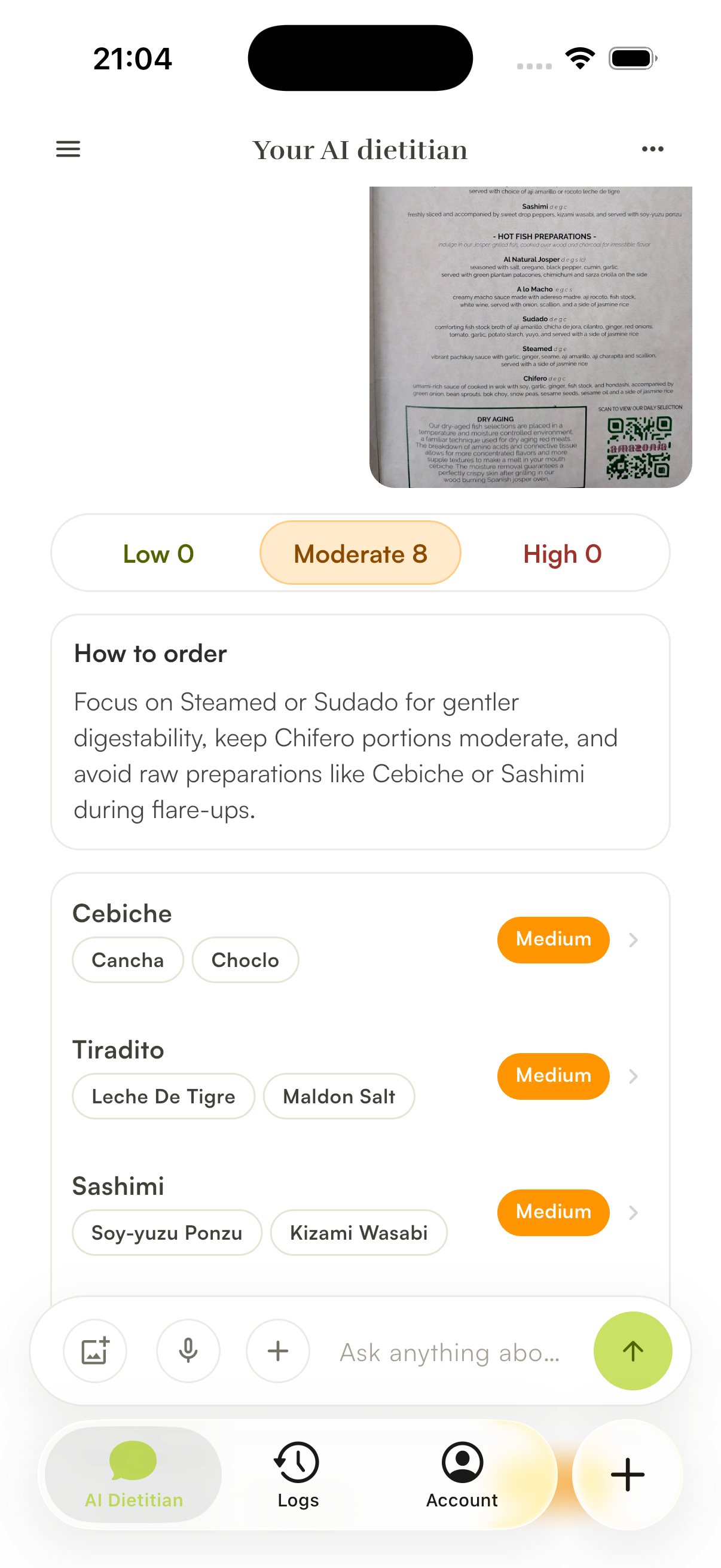
Whole-menu summary in Hara
A photographed restaurant menu receives an overall “How to order” summary above the individual dishes. This example discusses Steamed, Sudado and Chifero before listing dish-level results.
App screenshot. Open image to view full size.
Trade-off: Hara has a small public review base. Its AI may miss ingredients or misinterpret information; it cannot verify that a dish is medically safe.
mySymptoms: detailed food and symptom records
mySymptoms records food, drinks, medicines, symptoms, bowel movements, sleep and other factors. You can use a food database, barcodes and custom entries. Its analysis highlights associations, while PDF/CSV exports and mySymptoms Clinic support reviewing diaries with a professional.
Best fit: you want detailed, configurable records for a food investigation or care conversation. Trade-off: useful analysis still depends on consistent entries. The reviewed workflow emphasizes diary review; it does not establish dish-by-dish restaurant-menu guidance.
My IBD Care: an IBD-specific care companion
Ampersand Health's My IBD Care was developed with patients and clinicians. Its current listing covers bowel movements, symptoms, medicines, reminders, appointments, lifestyle context and expert-led courses. ElenaAI offers non-medical guidance using recorded patterns.
Best fit: you want IBD-specific education and help preparing for care between appointments. Trade-off: connected-care access can depend on your provider, and the reviewed sources did not establish dish-by-dish menu analysis. It serves a broader IBD routine than a food-checking tool.
Monash FODMAP: tested foods and structured reintroduction
The Monash FODMAP app comes from Monash University and combines a tested-food guide, serving-size traffic lights, recipes and a diary. It includes guidance for FODMAP reintroduction and lets you export records of food, IBS symptoms, bowel habits and stress.
Best fit: your dietitian has recommended a FODMAP approach and you want the research team's food reference and reintroduction tools. Trade-off: it was designed around IBS. A food's FODMAP category does not establish whether it is appropriate for your current Crohn's or UC situation.
Spoonful: ingredient checks while grocery shopping
Spoonful checks packaged foods by barcode or photo and highlights ingredients relevant to selected dietary needs. It also offers product alternatives. Its FODMAP guidance explains that results estimate a product's FODMAP load at a serving, with larger portions potentially changing the interpretation.
Best fit: you want help reading labels and comparing groceries for a dietary approach you already follow. Trade-off: ingredient screening and personal meal–symptom history are different tasks. Pair product checks with a diary if you need to record what happened after eating; a scan cannot verify medical safety.
Bowelle: a simple food, symptom and bowel diary
Bowelle focuses on daily food, symptoms, stress, bowel movements, water and custom values. Its official FAQ describes meal photos, reusable food lists, charts and PDF/CSV reports. On iOS, Apple Health can add context such as sleep and steps.
Best fit: you want a straightforward way to keep digestive-health records and share a report. Trade-off: Bowelle is positioned around IBS and diary review. The reviewed sources do not establish an IBD treatment-management or restaurant-menu judgment workflow.
Bearable: see food alongside sleep, medicines and other factors
Bearable lets you create custom symptoms and track severity, food, medicines, sleep, mood, energy and activities. Its care-preparation guidance describes correlations, trends, a timeline and exporting records for your medical team.
Best fit: you want to view gut symptoms alongside other health conditions and daily factors. Trade-off: you need to decide which fields matter. It is a broad health tracker, so the correlations require interpretation in your own clinical context.
FoodMarble: breath readings alongside meal records
FoodMarble combines a food library, meal and symptom logs with readings from its breath-testing devices. AIRE 2 measures hydrogen and methane and sends readings to the app, where you can review them alongside meals.
Best fit: you and your clinician want to explore a device-supported fermentation record. Trade-off: breath testing requires compatible hardware and regular measurements. FoodMarble's support guidance says the devices do not diagnose medical conditions. These readings are not a measurement of IBD inflammation.
Cara Care: check the regional program
Cara Care has established digestive-health programs, but its products differ by region. The US IBS/FODMAP tracker listing describes food and symptom records and a dietitian-supported program; its last listed update is October 27, 2020. The current German offering follows a separate regional pathway.
Best fit: you are investigating guided digestive-health support available in your country. Trade-off: verify the exact app, eligibility and current support. Older US program descriptions should not be assumed to describe today's German product or a current IBD care service.
How IBS and FODMAP tools fit into an IBD routine
The Crohn's & Colitis Foundation explains that a low-FODMAP diet may help symptoms in some people with IBD and overlapping IBS, but has not been shown to reduce IBD inflammation. A FODMAP database or grocery scanner therefore answers a narrower question than disease monitoring.
Use your IBD team's advice to decide whether a dietary approach fits your needs. Symptoms, dietary tolerance and active inflammation are related questions that an app cannot resolve from a food score alone.
Before you commit to an app
- Choose one job first. Is the difficult moment ordering food, reading a grocery label, logging symptoms or preparing for a visit?
- Check what your care team can use. Try a sample report or ask whether they accept a PDF, a diary or portal access.
- Check how personal history is used. Can the app retrieve a past meal and its outcome when you ask about another food, or does it mainly show retrospective charts?
- Review health-data choices. Read the privacy policy, what goes to an AI provider, sharing controls, and export or deletion options.
- Record ordinary meals too. Note timing, portion, preparation and what happened afterward, including no noticeable symptoms.
The NIDDK notes that a food diary can help identify foods that seem to worsen symptoms. The Crohn's & Colitis Foundation distinguishes symptom triggers from inflammation: an association in a diary cannot prove what caused a flare.
For a practical format, read how to turn a diary into a better GI visit and how to build a personal UC food profile. An app should not delay care for new or worsening symptoms or replace prescribed treatment.
Sources and disclosure
Hara Health makes Hara and publishes this article. We used internal competitive research to select eight established alternatives by product history, public adoption signals or institutional backing, then checked official product pages and store descriptions on October 14, 2026. This compares published features, not clinical efficacy or hands-on testing.
Some tools focus on IBS or specific diets. “Not established in reviewed sources” means an evidence gap, not confirmed absence.
Frequently asked questions
What is the best app for Crohn's disease or ulcerative colitis food tracking?
Consider Hara for menu checks informed by personal meal history, mySymptoms for detailed food and symptom diaries, and My IBD Care for IBD education and care preparation. Choose the workflow that fits your needs.
Which app helps compare restaurant menus for IBD?
Hara analyzes a photographed menu dish by dish and connects food checks with personal history. Confirm ingredients with restaurant staff; AI menu analysis cannot establish whether a dish is medically safe.
How does Hara differ from mySymptoms?
Hara emphasizes pre-meal menu, photo and label checks informed by prior meal responses. mySymptoms emphasizes detailed diaries, food–symptom association analysis and PDF/CSV or Clinic sharing. Both support reviewing records with your care team.
Which apps let me share food and symptom records with my GI team?
Hara offers health-report export and Care Portal. mySymptoms offers PDF/CSV and Clinic sharing; Bowelle provides PDF/CSV reports; Monash supports diary export. Ask your GI team which format fits their workflow.